How Can I Become a 21st Century Educator?
IT’S A NEW DAWN, IT’S A NEW DAY, IT’S A NEW LIFEEEE, AND I’M FEELIN’ LIKE A 21st CENTURY EDUCATOR
(love me some Michael Bublé)
I’m pretty sure back in the 20th century people
thought that by the 21st century life would be as depicted in
The Jetsons with the flying cars, cities in the sky, etc.
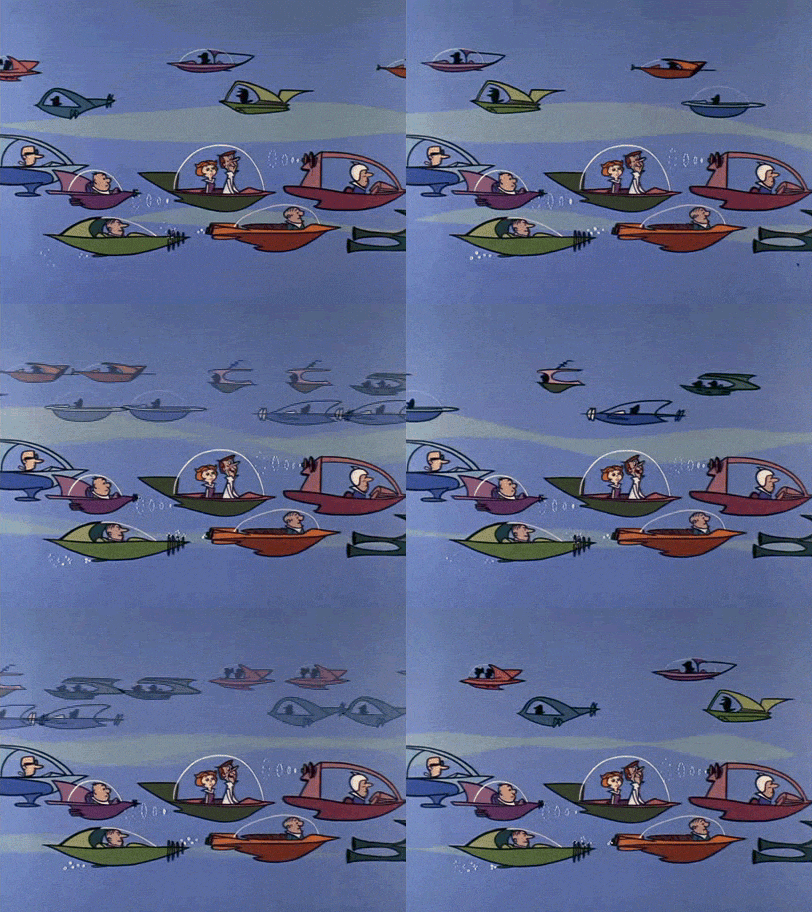
Sadly, that is not the kind of technology we have
today. We just have plain ol’ tablets, and smartphones, and iPads,
and iPhones, and computers, and laptops, and Internet, and YouTube, and
Instagram, and Snapchat, and a whole lot of other apps. Such a shame
we don’t have Rosie the Robot Maid ... Oh s***, does the iRobot Roomba count as
a robot maid? 🤔 🤔 🤔 🤔
Although life in the 21st century is not exactly
like life in The Jetsons cartoon, it is still an age of technology – it’s the
“digital age.” Being a teacher in the digital age places a new
responsibility on teachers. As an educator, it is essential to
incorporate 21st century technology into our classrooms to help
our students develop 21st century life
skills. According to my class textbook, Transforming Learning with
New Technologies, “To prepare everyone for productive lives and fulfilling
careers, teachers are expected to convey 21st century skills to
students. 21st century skills represent the knowledge and
understandings that students will need to succeed in our highly technological,
information-based society, including the ability to think critically, make
informed judgments, solve complex problems, think creatively, communicate and
collaborate with others, use information in innovative ways, and take
responsibility for one’s personal and civic life” (Maloy, Verok, Ruth-Ellen, Sharon,
& Woolf, 2017, p. 23). The image below incapsulates the
variety of 21st century skills and its intersection with the
teaching realm.

Now, how can I become a 21st Century Educator? This is a GREAT question. Let me create a list:
· I can use 21st century
technologies in my lessons.
· I can blend the content I want to
teach and the activities I originally planned with technology to create a more
interactive, meaningful, and exciting experience for my students.
o Cells phones and social media is
super popular among middle school and high school students (the age a plan to
teach).
o As a 21st Century
Educator, I could create an assessment where students use Instagram to showcase
what they learned about WWII.
o For example, a student can choose
the Holocaust – their Instagram will consist of pictures, documents, etc. from
that event they think is important. Each image will have a thoughtful caption
with hashtags, students can tag individuals, and even put a location of the
image.
· Lastly, to become a
technology-leading teacher, I should develop a professional learning network
(PLN).
o “A PLN demonstrates your talents and
competencies as a teacher— showing what you know how to do instructionally and
professionally with the latest interactive tools (Trust, 2012)” (Maloy, et
al., 2017, p. 19)
o It is important for me, a new
teacher, to be a life-long learner and to constantly develop myself, learn
about the latest technology and educational trends, and to network by sharing
my ideas and my resources.
o In my graduate course we even
discussed certain platforms to build PLNs and digital portfolios to showcase
our work.
§ Platforms: Weebly, Wix, Blogger,
Google Sites, PB Works, EMaze
§ What it should showcase:
· Teacher work as a digital resume
· Reflections on teaching practices
and growth
· Lessons
· Philosophy of Teaching
· Contact Information
· Work Experiences
Reference
Maloy, Robert W.; Verock, Ruth-Ellen A; Edwards, Sharon A.;
Woolf, Beverly P.. Transforming Learning with New Technologies (What's New in
Curriculum & Instruction). Pearson Education. Kindle Edition.


Hi Gabby!
ReplyDeleteI agree with you, since I think it is quite important that, as 21st century educators, we learn to take risks in the classroom. This is due to the fact that technology is becoming an increasing part and feature in our classrooms. As the technological innovations grow, so too does our need to take risks in the classrooms and to adapt with them.
-Alex